Posts

Showing posts with the label ANDROID

Chess Board Detection

Image
 Chess Board Detection ✔️  Introduction Chinese chess is one of the most popular board games in China. It is a two-player strategy board  game set up with 32 chess pieces on a board nine lines wide and ten lines long. The chess pieces  are all of the same flat circular disk shape. Each piece is labeled with a Chinese character to  represent one of the seven types. The color of the piece indicates the player‘s ownership. ✔️ Project Goal The goal of the proposed project is to correctly recognize the state of a Chinese chess game by  processing the images captured by the camera of an Android mobile phone. With the essential  information extracted from the images, we will be able to save and share the record of a game  very efficiently. ✔️ Work Flow To reach the goal, we need to detect the chess board, identify the location of each chess piece and  recognize the type of the piece. Chess Board Detection To ext...

PCA and LDA for Iris Recognition

Image
✔️   PCA and LDA for Iris Recognition  ✔️   Project Description: The aim of this project is to use Principal Component Analysis (PCA) and Fisher Linear Discriminant  Analysis (LDA) methods for iris recognition. Daugman’s algorithm [1] from 1993 is the foundation for  many modern iris recognition techniques with very low, unmatched, error rates. However, this method  is computationally expensive [2], thus other mathematical models have been pursued.  Using the PCA and LDA methods for iris recognition has shown promising results with fast computation  times [3]. These methods would train an algorithm from a large dataset of irises, available from the  CASIA Iris Image Database Version 4, which has a range of different classes (twins, iris-at-a-distance, glasses, etc.). The rough outline of the algorithm would include: • Image segmentation to identify iris and pupil • Occlusion removal, such as eyelashes • Eigenvector decomposi...

aerodynamic performance

Image
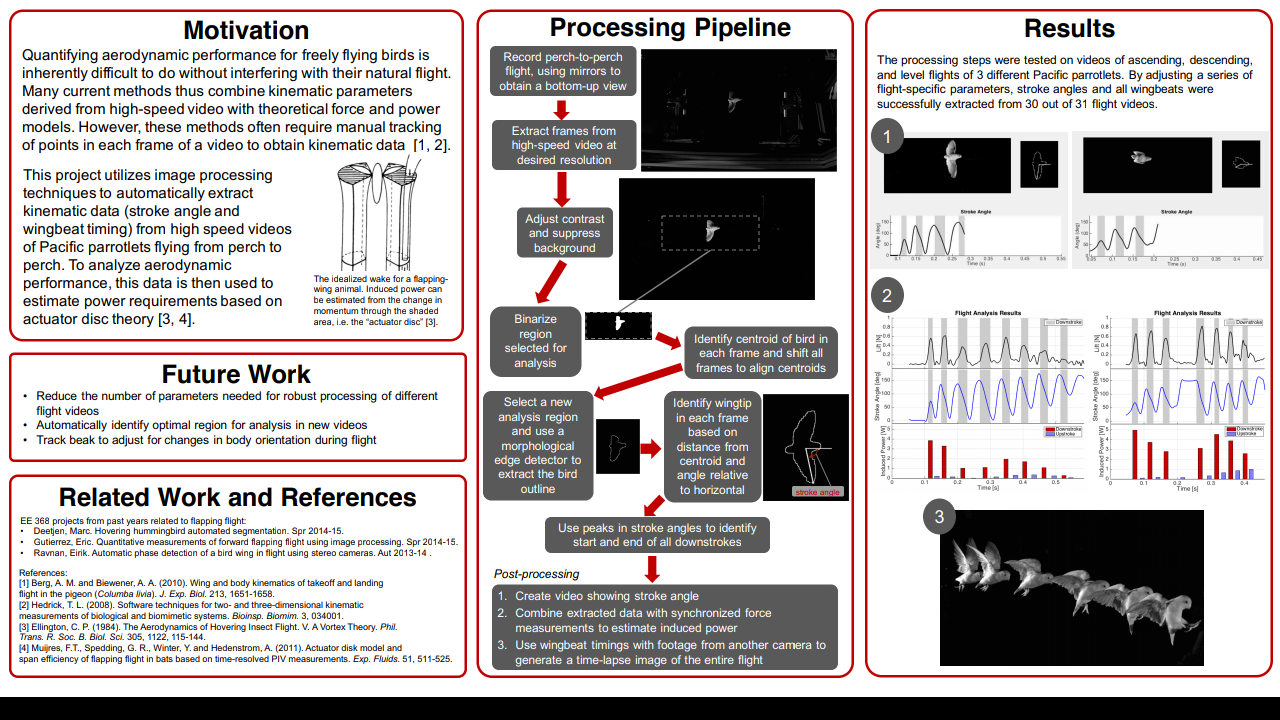
✔️   AERODYNAMIC PERFORMANCE DURING FLAPPING FLIGHT ✔️   Background and Motivation Quantifying the aerodynamic performance of freely flying birds is an open challenge in the field, because it is inherently difficult to directly measure the forces generated and the power required by flapping wings without impeding their natural motion. Force estimates are thus frequently derived from kinematic analysis of high speed video. Acquiring this data has traditionally involved tracking markers on the bird, as in [1], using software tools, such as the DLT program described in [2]. Although this program has some automatic tracking capabilities, they only work well with very clearly visible markers and relatively uncluttered backgrounds. However, artificial markers may interfere with the flight of smaller birds. Natural landmarks, such as the eye of the bird, ...