Posts

Showing posts with the label PROJECT SOURCE CODE

Digital Make up Face Generation
Image
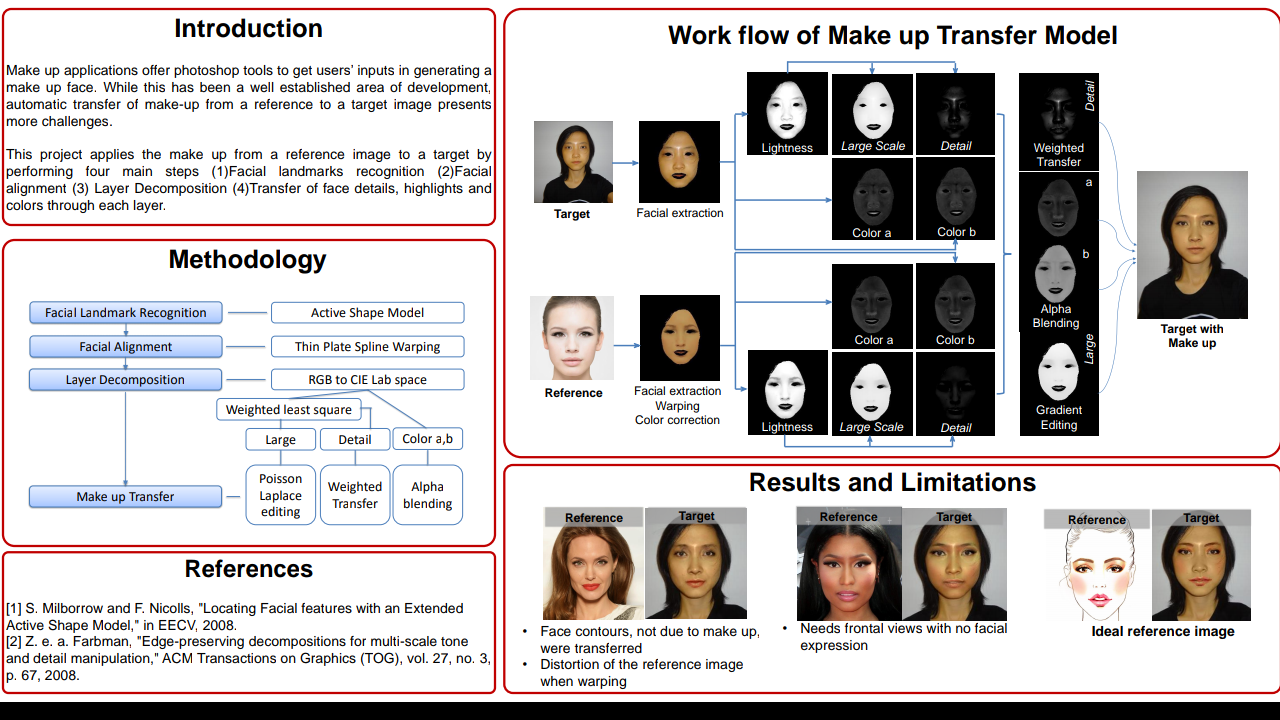
Digital Make up Face Generation Goal Current make-up applications rely on using photoshop tools to apply makeup on the target's digital  faces and generate results. While these applications allow customization, a customer who wants to  quickly decide on the type of makeup kit to buy at a store will not find it useful. The customer might just  want to find out how the make-up look on the cover or billboard will look like on her face. The goal of  this project is to use an existing reference image of another subject with a make-up applied, and  transfer the reference's make up on the target's face. The application can be further extended to photo  retouching and illumination transfer from the reference image to the target. Methodology In order to transfer the make-up from the reference onto target in a pixel by pixel basis, the areas of  interest must align. Face features such as eyes, nose, mouth and contours of the face, will be recogniz...

Image Processing Pipeline for Facial Expression Recognition under Variable Lighting

Image
Image Processing Pipeline for Facial Expression Recognition under Variable Lighting 1 Introduction Automated facial expression recognition has proven to be beneficial in a variety of settings. For instance, in the Wall Lab of Stanford Medical School, expression recognition is used in a Google Glass application that helps children and adults with Autism detect the emotions of people they are interacting with. Thus, research into increased classification accuracy for expression recognition can have great impact. Many studies addressing this subject use images with uniform lighting conditions[1]. This is understandable because it allows for accurate evaluation of the recognition algorithm. However, for most practical applications, the emotions recognition task is done in real-world conditions where the lighting is diverse and far from being uniform[2]. In this project, we aim to study the effects of different lighting/shadowing on the emotions recognition task and find t...

Create Pointillism Art with 3 Primary Colors from Natural Images

Image
Create Pointillism Art with 3 Primary Colors from Natural Images Description Pointillism is a branch of impressionism that can be dated back to the late 19th century. It is a painting technique that only uses tiny, distinct dots to form patterns of color. It enjoys a duality in being both discrete up close (the dots) and continuous from distance (the patterns). Combining this artistic inspiration with the techniques of digital image processing, we want to develop a special image filter that creates pointillism art from ordinary digital images. Plan he process of creating pointillism art will be as followed: (1) We take an image. (2) We will apply various image processing techniques to our image, such as blurring the image with a structuring element that is larger and proportional to the size of the dots we want to use in our pointil...

Automatic Cell Detection of Liver Tissue Section Image

Image
Automatic Cell Detection of Liver Tissue Section Image 1 Introduction The Nusse Lab of the Stanford Institute of Stem Cell Biology & Regenerative Medicine studies the regenerative properties of the liver. The goal of this project is to help graduate students in the Nusse Lab automate the tasks of cell counting and characterization of liver tissue section images, leveraging image processing and machine learning techniques. Currently, the cell counting tasks of tissue section images are done by hand, in a manual and laborious manner, because general purpose image processing software such as Image J does not adequately address the specific need for these types of images and there are no commercially available products solving this problem [Gri15]. While previous projects have dealt with cell counting or characterization of cell culture images, this project tackles the more difficult problems presented by tissue section images due to their non-homogeneous nature and t...

Light Field Images for Background Removal

Image
Light Field Images for Background Removal OUTPUT OVERVIEW Standard edge detection or foreground/background separation techniques, such as Otzu’smethod, require color or intensity differences between the background and regions that need tobe separated. For example, green screens are routinely set up as the background in a scene so thatthere is a clear difference in color between the background and foreground.Light filed images, captured in 4D and passively containing depth information for thescene can be used to approximate this effect. Depth estimation in the scene alone could provide a metric to separate the foreground and background, but more sophisticated methods are available.Considering the edge detection from a single image from a single viewpoint and analyzing the depths from the light field around the edges in that image, occluded edges and intensity or color edges can be distinguished. Along with the rest of the depth information this can allow the foreground and b...

InSAR-derived Active-Layer Thickness Distributions

Image
InSAR-derived Active-Layer Thickness Distributions Background: Large-scale thawing of arctic permafrost has a poorly-understood feedback effect on global climate through the release of CO2 and methane. Active Layer Thickness (ALT) is the maximum annual depth of thaw of surface soils and is designated by the World Meteorological Organization (WMO) as an essential climate variable for monitoring the status of permafrost.Interferometric Synthetic Aperture Radar (InSAR) is a widely-used geophysical technique for measuring surface deformation at high spatial resolution (Rosen et al. 2000). In recent years, InSAR has been successfully used to measure ground deformation due to seasonal permafrost freeze/thaw cycles and invert this deformation signature for a spatially extensive and finely-sampled map of ALT (Liu et al. 2012; Schaefer et al. 2015). Proposal:  The ALT retrieval algorithm developed by Liu et al. 2012 generates continuous spatial solutions of ALT within an indiv...

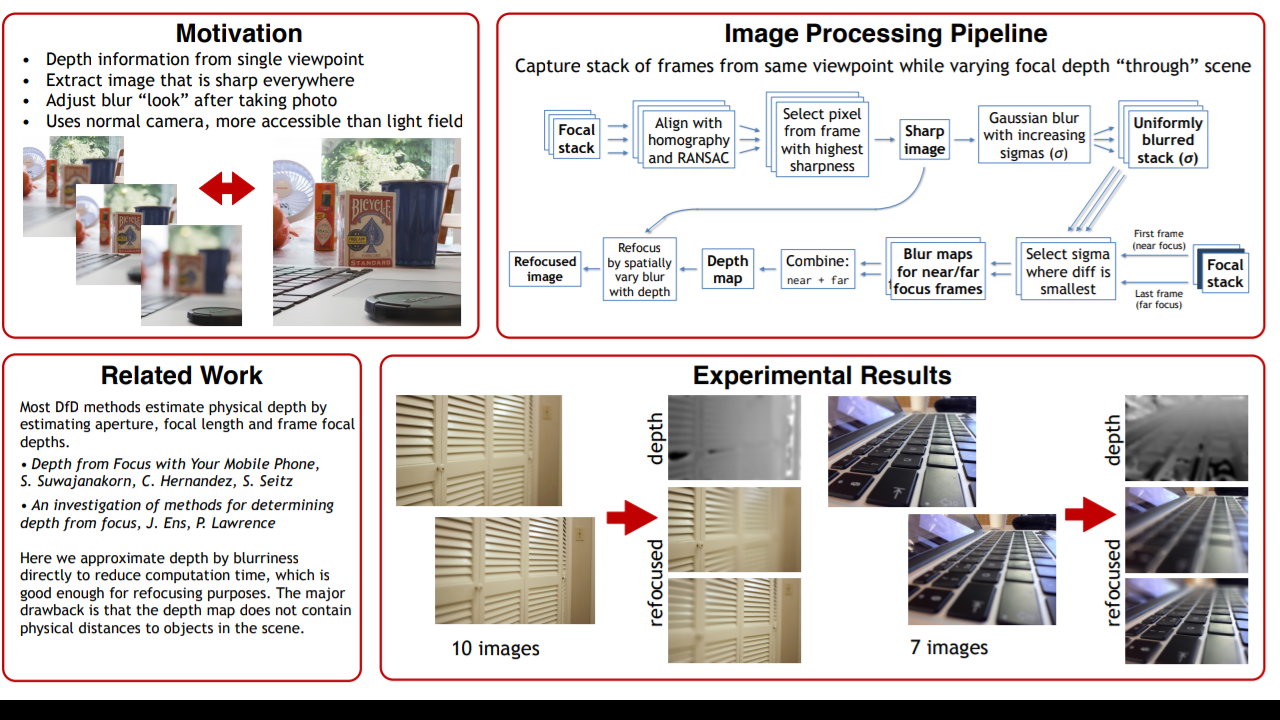
Depth from Defocus for Mobile Cameras

Image
Depth from De-focus for Mobile phone camera Output OVERVIEW Depth from Defocus (DFD) is a technique in which a depth image of a scene is reconstructed from multiple images with varying camera parameters from a single camera [1]. Parameters that affect defocus characteristics of an image are; distance to the focus plane, the focal length, and the depth of field which is controlled by the aperture size. I would like to explore and implement DFD methods on smartphones [2]. My aim is to display a captured scene with a some kind of 3D technique, i.e. parallax mapping. A use for this could be simple capturing of 3D photos of people or of sculptured art. Technical Details In the first stage I will implement a DFD method in MATLAB with image stacks taken by a stationary DSLR camera, i.e. no translation or parallax between images. This will give me a solid understanding of the mathematics behind the optics and the algorithms. In the second stage I will extend the above me...

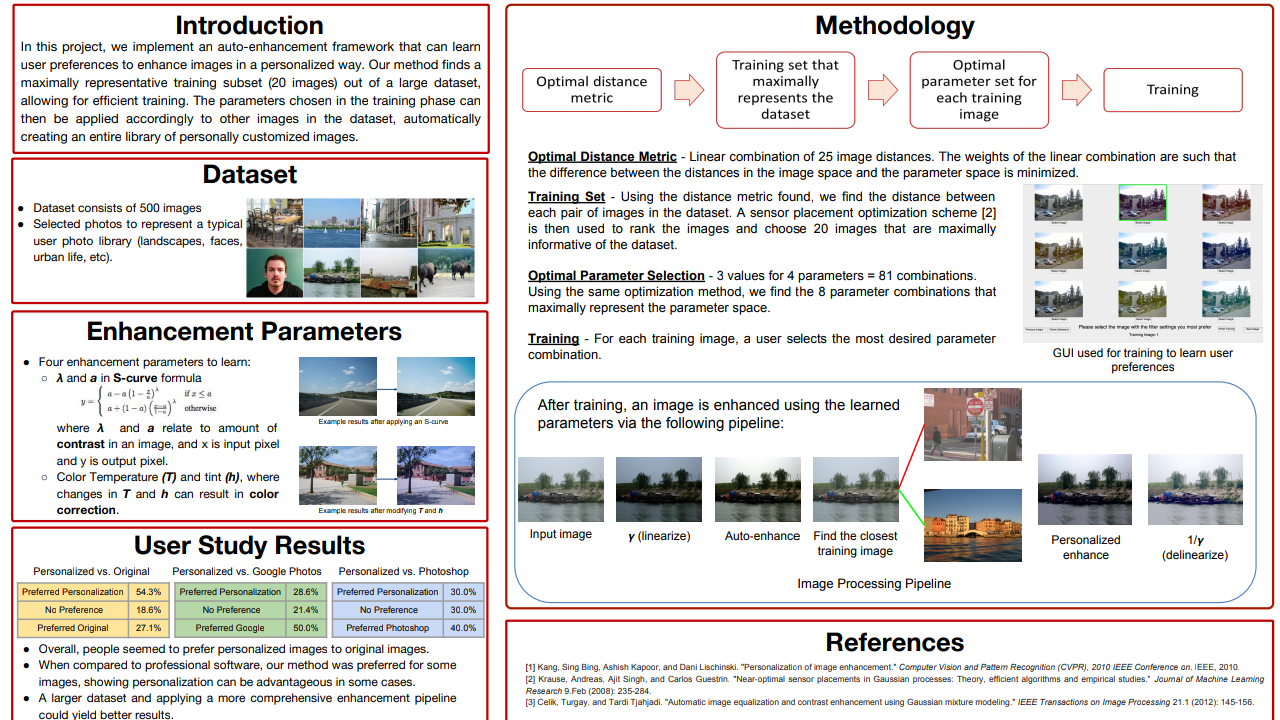
Image Enhancement using Machine Learning

Image
Image Enhancement using Machine Learning OUTPUT OVERVIEW Automatic image enhancement is an active field of research and is used widely in professional image processing software. For our project, we want to create an automatic image enhancement tool that learns a user’s preferences so that subsequent images can be automatically enhanced in a personalized way. Our work will be mainly derived from [1]. The parameters learned in [1] are associated with contrast and color correction. We will attempt to learn these parameters, and if time permits, experiment with other parameters as well. The first part of this project is to select an optimal subset of training images from a large set of images, using the optimization technique described in [1] and [3]. The subset will be around 15-20 training images. For each training image, there will be a large possible number of combinations of parameters (depending on how many we choose to learn). To reduce the subset of possible param...

Panorama Based on Light Field Images

Image
Panorama Based on Light Field Images OUTPUT Introduction: Light field camera captures an array of images by microlens near the detector while traditional camera  just takes one 2D picture of a 3D scene via one single lens. Though the resolution is not as good as  traditional camera, light field device still brings a lot of advantages in many ways [1,2]. For example,  depth detection, post-focus, 4D feature detection or even animated thumbnail 3D camera shake are  feasible from processing light field images. In the recent years, panorama is also developed as a picture  containing a wide viewing angle which is usually achieved by stitching a couple of 2D images  together[3,4]. Our project will look into rendering panorama pictures by stitching individual light field  images which will both contains a wide viewing angle and has the ability to calculate a lot of depth  related characteristic via MTALAB Light Field Toolbox. Objective Ach...

Cell Segmentation in Slide Images

Image
Cell Segmentation in Slide Images Output OVERVIEW The advent of whole slide images (i.e. digitally scanning pathology slides can help usher in a new era of quantitative analysis of tissue samples. Whereas traditional judgments are made subjectively by a pathologist, image processing and computer vision algorithms can help determine cell densities in neoplasmic tissues, quantify the amount of Her2 in breast cancer, and much more. One of the largest challenges in digital pathology is accurate cell segmentation. In tissue samples, cells are closely packed, and sometimes overlap since the tissue being imaged is actually a 3D specimen, of which we are taking a 2D image. We propose to develop an image processing algorithm for segmenting distinct cells in tissue samples. A number of algorithms have already been proposed for this, including Euclidean distance transform, watershed segmentation, a combination of morphology operators, Laplacian of Gaussian filters, MSERdetectors, an...

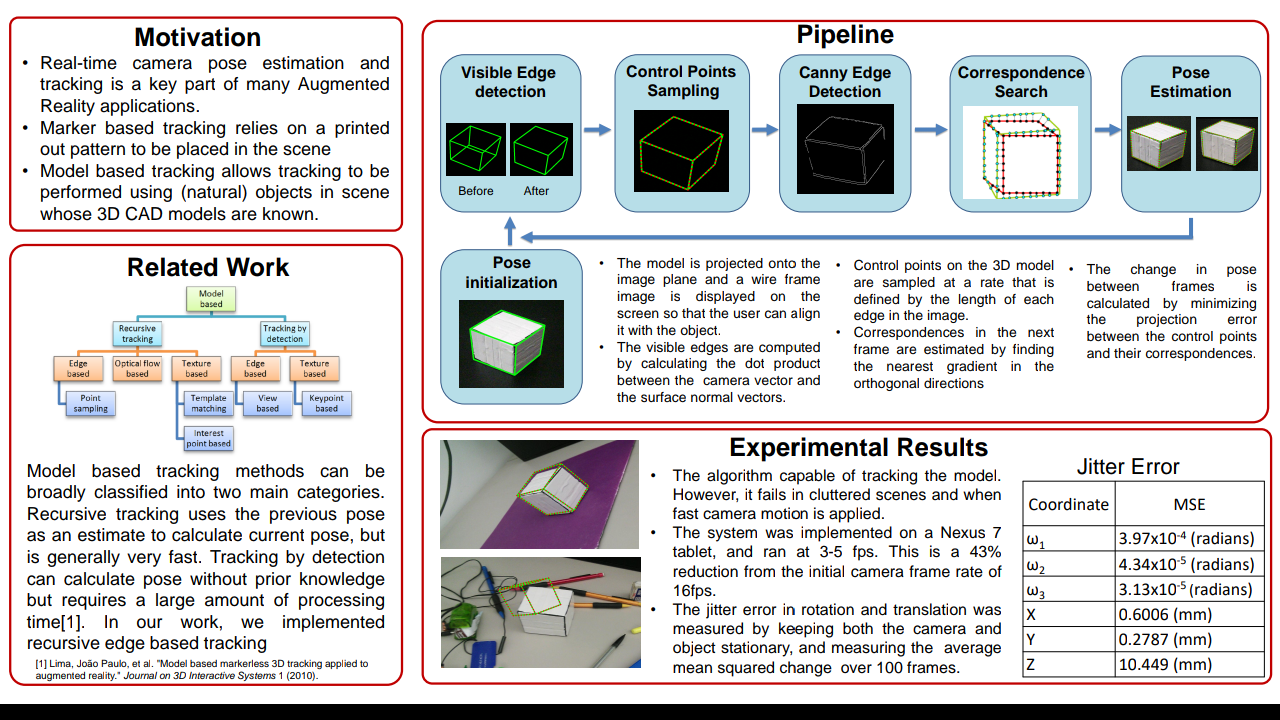
Model based markerless tracking

Image
Model based markerless tracking OUTPUT OVERVIEW For our project we would like to implement a markerless augmented reality application on a mobile device. We would like to use an android device for this project. The goal of the project is to implement a real time tracking system using a model of a simple object, like a rubik’s cube. The principal deliverable in this project is a model-based tracking system implemented on a mobile device. We plan to implement the tracking algorithm ourselves. We will not use any in-built tracking tools available in ARtoolkit. Milestones : Camera Calibration: The first step in the project is to calibrate the camera on the mobile device.Accurate camera calibration is essential for implementing a good tracking system. This can be done using the Camera Calibration plugin provided by the ARToolKit orMATLAB. Object tracking and camera pose estimation: Next we would like to estimate the camera’s pose by using a control object whose CAD model i...

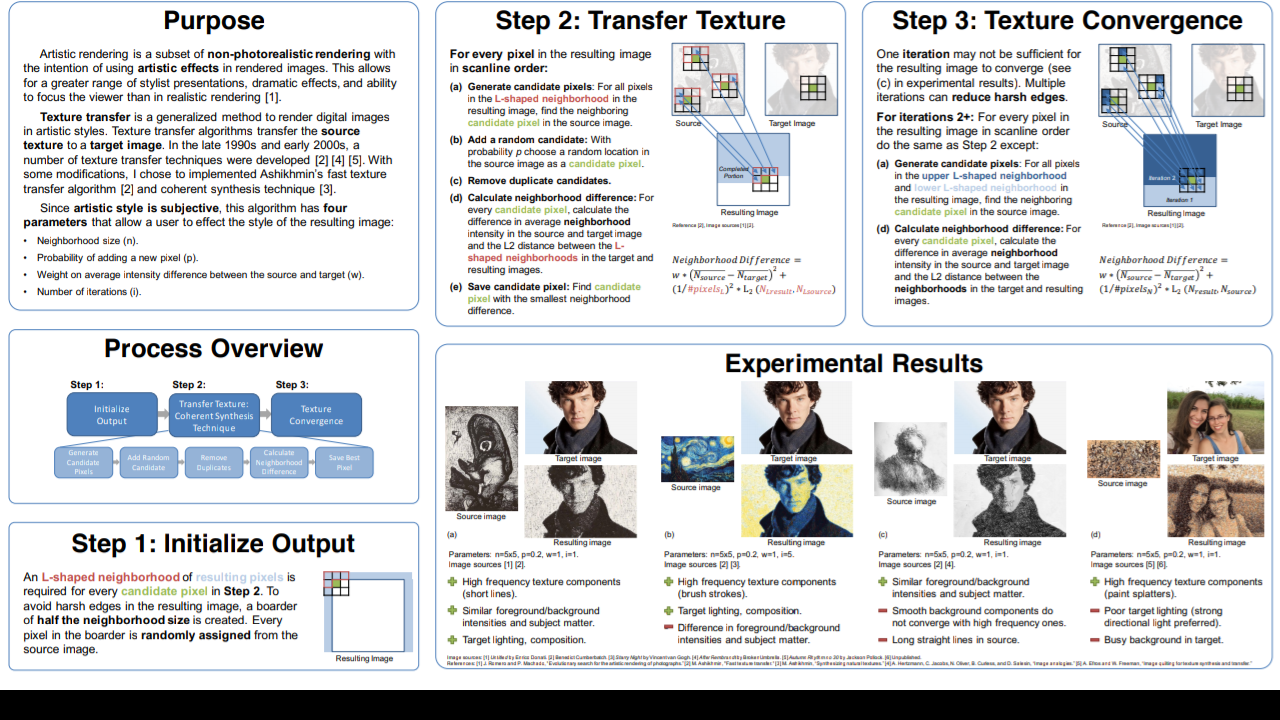
Creating Drawings from Digital Images

Image
Creating Drawings from Digital Images Description There are many algorithms out there for non-photorealistic rendering of images to look like   drawings. Jin et al and Li et al create drawings from images by creating directional lines that   match the intensity of the image. However, the resulting images don’t stylistically look like an   artist drew them. Efros et al found that image quilting can be used to transfer a specific drawing   style to an image such that it looks like it has actually been drawn by an artist. I will attempt to  implement his algorithm to create drawings from digital images. Plan I believe the following steps will be necessary to creating drawings from digital images that  resemble the drawings of famous artists. 1. Split the source texture (for example Enrico Donati’s drawing) into overlapping blocks of  size B. 2. Split the source image into overlapping blocks of size B. 3. Choose a block f...

Plane Extraction on Surfaces

Image
Plane Extraction on Surfaces OUTPUT Description :  The use of SLAM has many applications in drones and augmented reality to track the 6DOF  position of the camera. Currently there are two state of the art methods: ORB-SLAM and LSD-SLAM. We would be choosing to use ORB-SLAM because of the speed benefits of constructing a sparse feature  map instead of a dense feature map and its robustness in tracking from literature. On the other hand, an  implementation of semi-direct visual odometry is similar to ORB-SLAM but uses direct methods by use of photometric error to estimate pose instead of feature-based methods in SLAM which allows for speed-up. For now, we plan on using ORB-SLAM because of Android support online, but if possible we would like  to use the implementation of Semi-Direct Visual Odometry to do the tracking since it is faster, however  there is no loop closure or relocalization included with the open-source code at the current time....

Thumbnails for Light Fields

Image
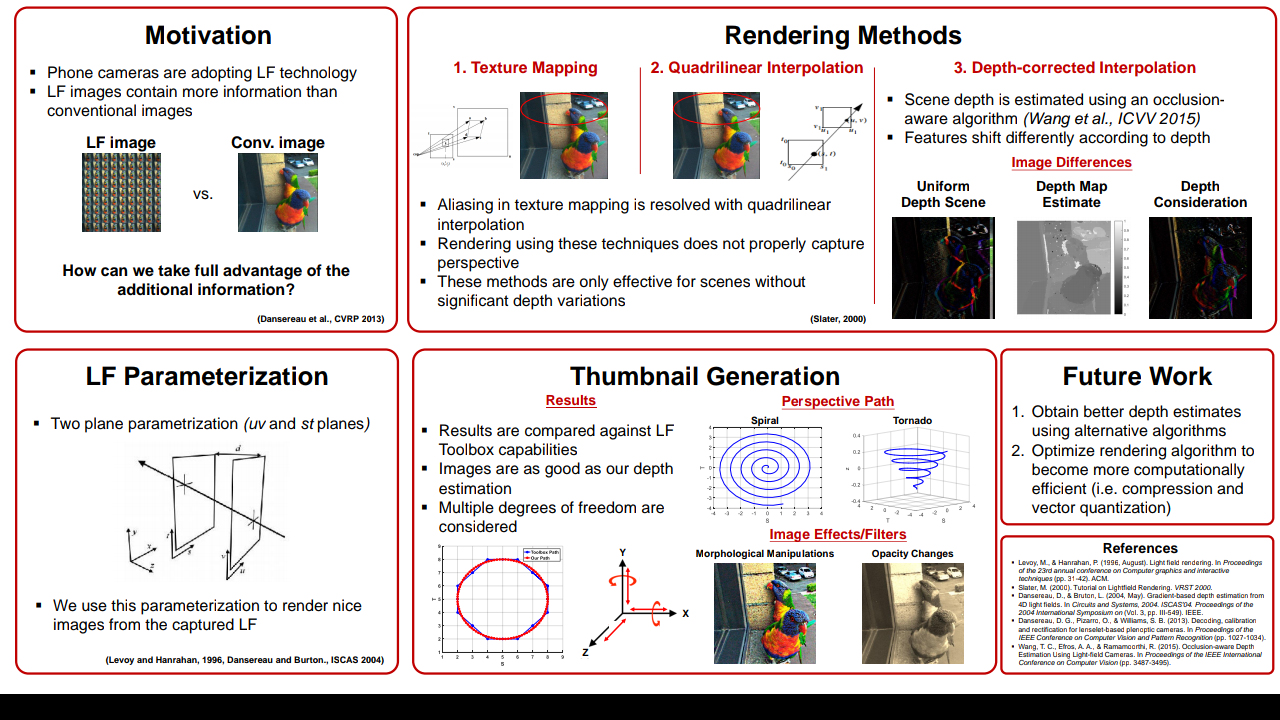
Thumbnails for Light Fields OUTPUT Background and Context: Light field (LF) cameras are gaining popularity because of advances in lens technologies and new  post-processing capabilities [1]. Consequently, new products are constantly being developed that  are designed to attract more consumers. For examples, there are currently several projects to  develop and apply LF technology on phone cameras (i.e. Linx and Pelican Imaging). As the  technology becomes more readily available to everyday consumers, new and creative rendering  procedures will be required to maximize the utility of the captured data. For the technology to be  adopted, the rendered images must provide fun/creative attributes that are beyond conventional  image manipulation (i.e. social media). Project Goals: Given the growing availability for consumer cameras, there is an increasing potential for using light  fields online in applications such as social media or adverti...